Tattva Vision The Elements of Divination and Magick
What are Tattvas?
Tattvas (or Tattwas) are aspects of material reality and sensory experience recognized by various Indian philosophies and spiritual traditions, notably Hinduism and Tantra. Related concepts are also found within Jainism and Buddhism.
The tattvas are most commonly associated with the Samkhya school of Hindu philosophy. Samkhya dates back more than 2000 years and provides the theoretical foundation of classical Yoga.
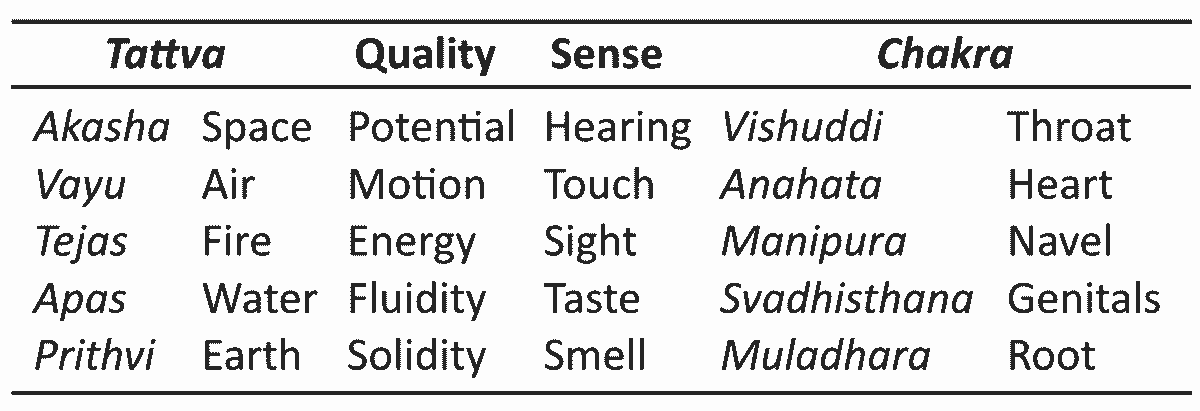
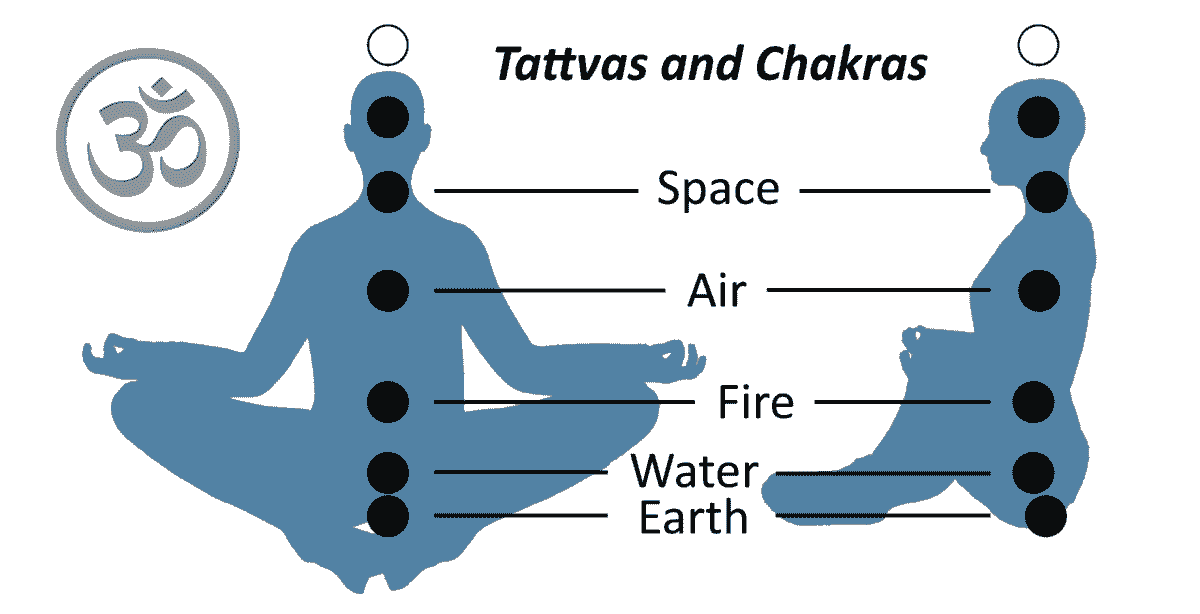
Although interpretations and classifications of the tattvas varies between schools and traditions, 25 tattvas are generally accepted. These derive from the doctrine of the five elements of the material world and the corresponding five dominant human senses. In Tantric traditions, the tattvas are also associated with specific chakras or centers of psychic energy.
The Western Elements
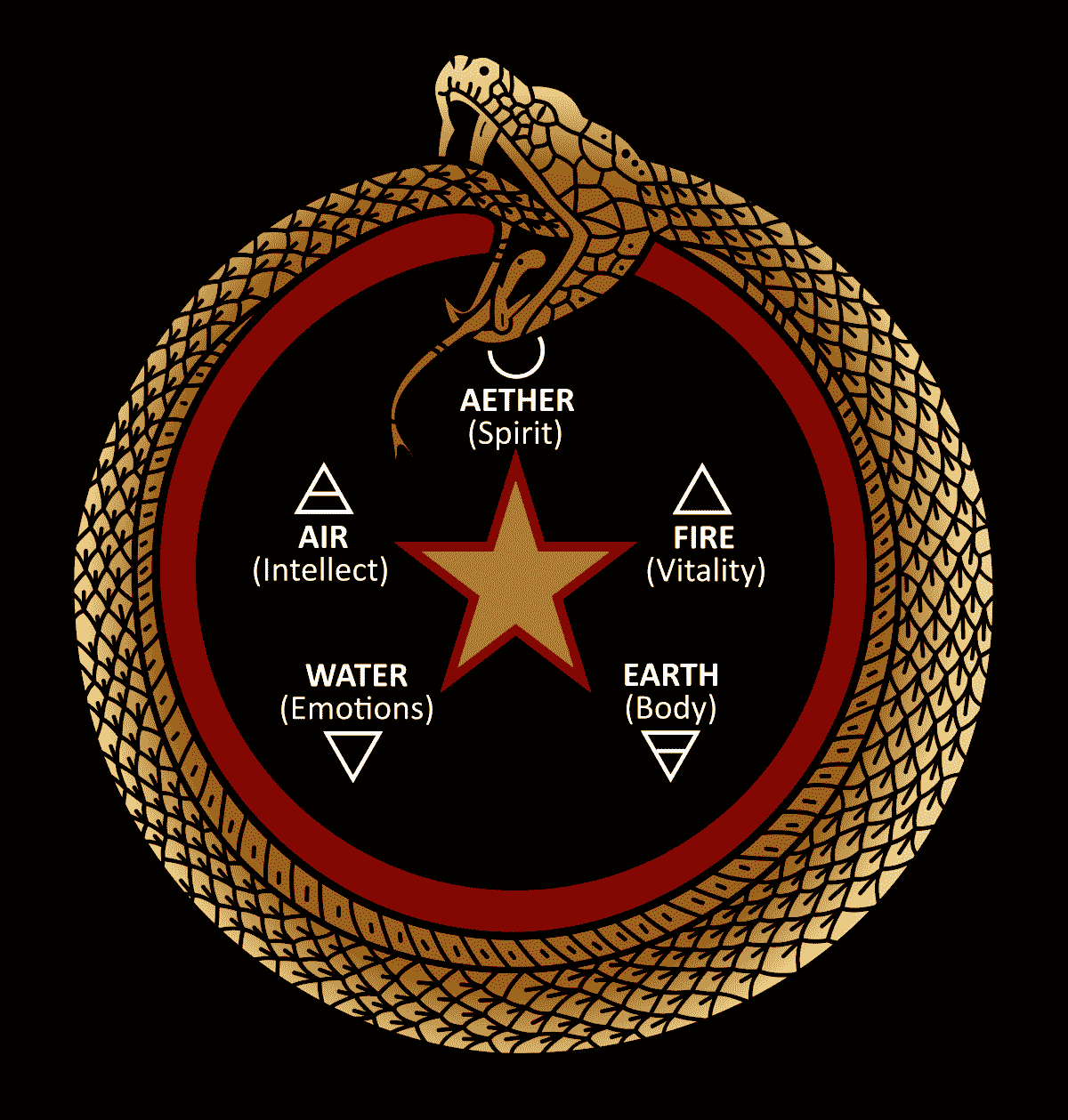
The tattvas of Samkhya philosophy have direct parallels in the doctrine of basic elements recognized by ancient Greek philosophers. Originally there were four such "Classical Elements" - Earth, Water, Air, and Fire. Aristotle added a fifth - Aether or Quintessence (equivalent to Akasha or Space).
In the Hellenistic, medieval and Renaissance periods, understanding of the classical elements was developed by Neoplatonists, Hermetic thinkers, and alchemists. One important idea linked the elements to faculties of the human soul or personality.
In this way, Air became associated with intellect, Fire with will or vitality, Water with emotions, Earth with the physical body, and Aether with spirit.
The Western Classical Elements
West Meets East
The 19th Century saw a revival of interest in Hermetic and occult knowledge. Asian philosophies were also introduced to the West by scholars, Theosophists, and Indian teachers. In this melting pot of ideas, the tattvas and chakras became incorporated and reinterpreted within Western Magick.
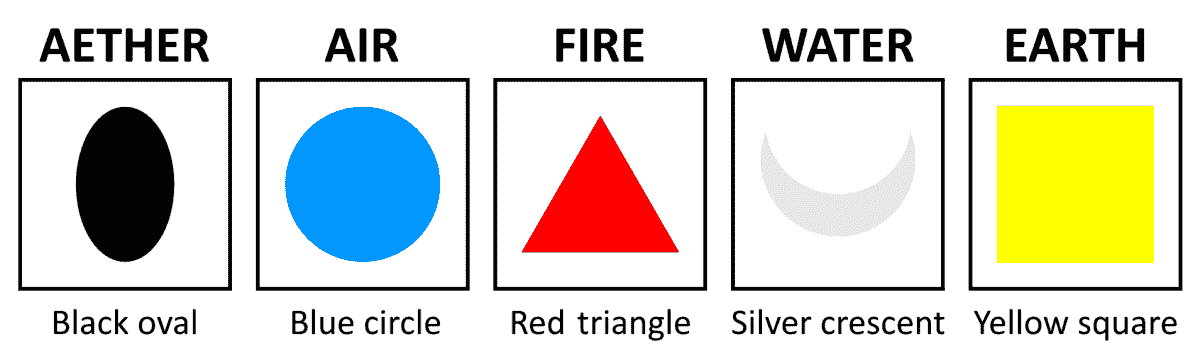
One consequence of this assimilation was a novel use of tattvic symbols and colors to represent the five elements.
Tattvic Elements in the Western Magical Tradition
The 25 Tattvas
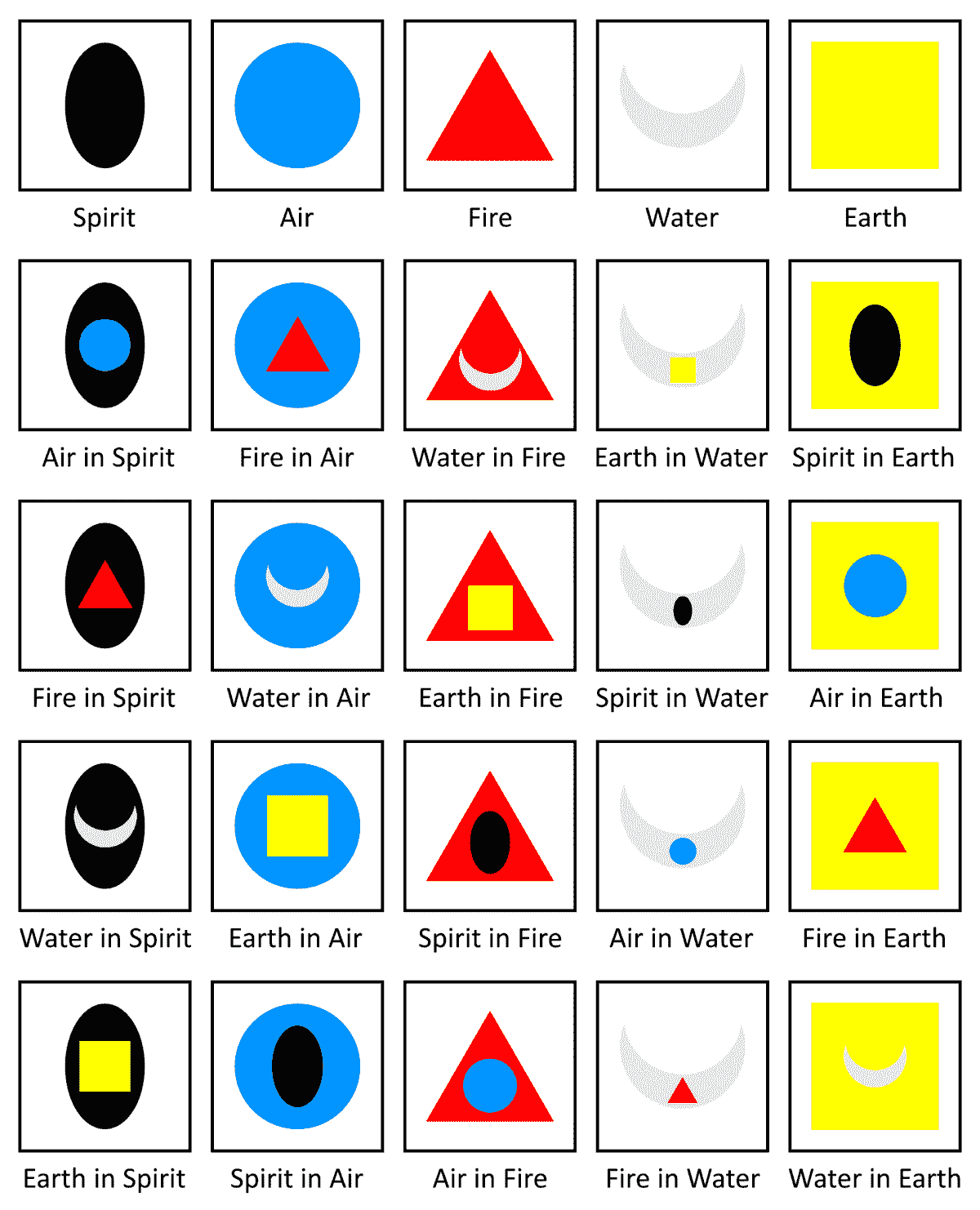
The 25 tattvas comprise the five elements, together with the 20 ways in which two elements can combine, resulting in a more sophisticated analysis of human experience.
The 20 combinations are represented by placing one symbol (indicating a potentiality) inside a second symbol (indicating its principal manifestation).
The 25 Tattvas
Tattva Divination
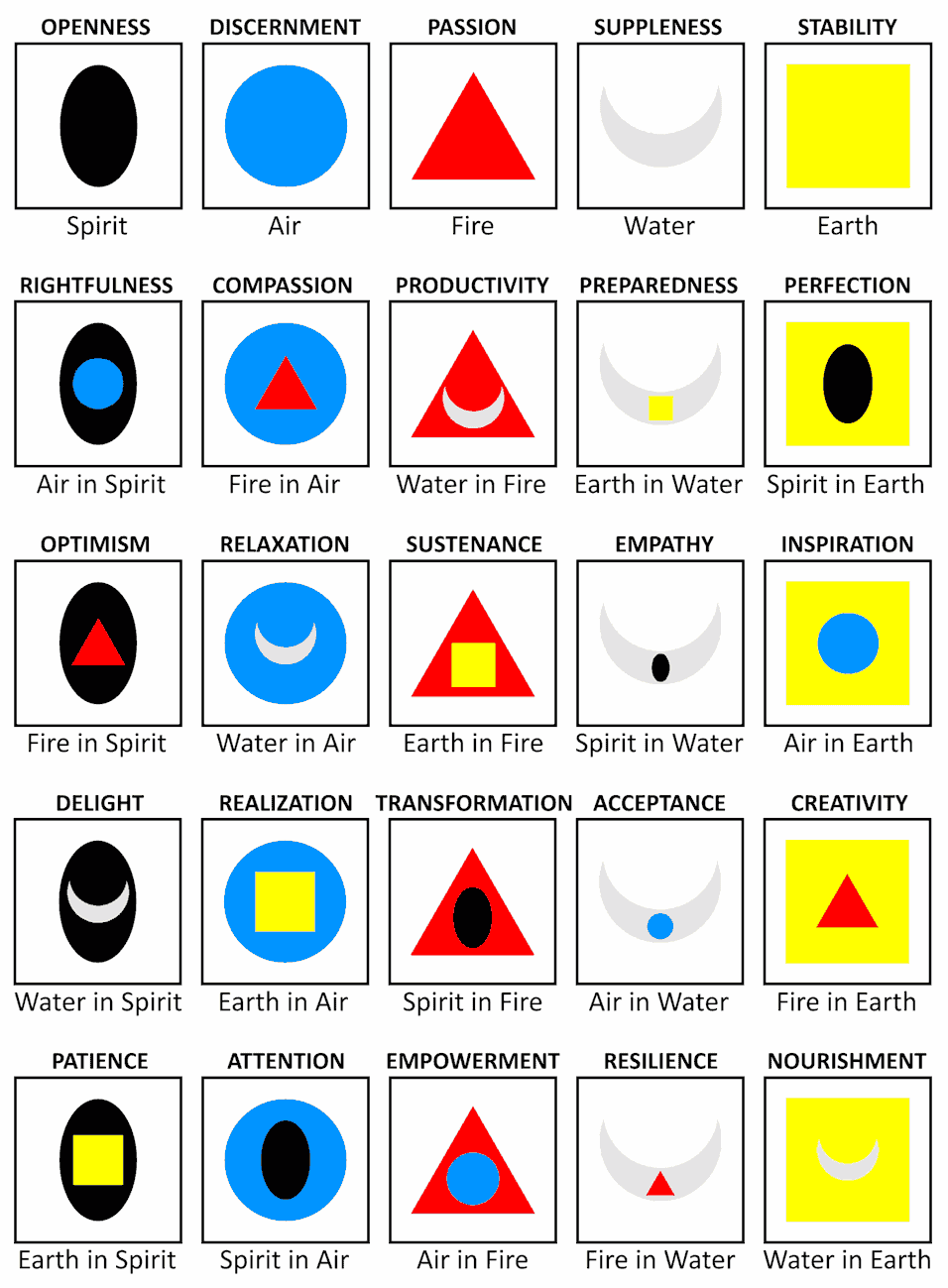
One important application of tattva symbols is divination. Because the tattvas express either a single principle (e.g., "Fire"), or a combination of principles (e.g., "Spirit in Earth"), each symbol represents a fundamental personal quality or virtue that reflects these principles. For example, "Fire" represents Passion, and "Spirit in Earth" indicates Perfection (the physical manifestion of spiritual potential). Keyword attributions for all 25 tattvas are shown below.
Tattva Principles and Qualities
Since the tattvas express personal qualities or virtues, they are best suited to obtaining advice on how to approach a situation, and for questions relating directly to your personal or spiritual development. For this reason, keeping a record of your readings in a personal journal is highly recommended.
The best questions take the general form:
"What should I seek to find or express in this situation?"
or
"What lessons can I learn from this situation?"
Tattva divination is therefore more focused than other oracles such as Tarot, I Ching, or Geomancy. While it does not provide a detailed analysis of the situation, or offer specific recommendations, it is ideal when seeking guidance on a general direction of appropriate stance to take.
You can use our interactive Tattva Oracle below to generate your readings. It will help if you spend a few moments to focus on your intention before you click the screen.
psychic.tools
Tattva Oracle
To interpret a tattva symbol, reflect on the meaning(s) of its keyword, and on how it may relate to your situation and question. You should also consider the tattva's elements, shapes and colors, allowing these to suggest additional meanings and symbolic associations.
Training the Mind's Eye
The ability to form mental images and see with the "mind's eye" is the basis of many psychic capacities and experiences, including clairvoyance, remote viewing, scrying, astral projection, vision quests, dreamwork, spell casting, chakra stimulation, and psychic healing.
Learning visualization techniques is therefore foundational to many systems of psychic and spiritual development. In the East, visualization exercises are central to Raja and Kundalini Yoga, Tantra, and Vajrayana Buddhism. In the West, training in visualization features in the "Spiritual Exercises" of the Jesuits, Kabbalah, and the Western magical traditions, including Wicca.
Visualization exercises also have many secular applications. Mnemonic techniques and the "Art of Memory" date back thousands of years and, in recent times, the importance of "mental practice" has become increasingly recognized in the training of musicians, athletes and surgeons, as well as in physiotherapy and recovery from strokes.
Within psychoanalytic circles, the role of visualization as a means of exploring and integrating the unconscious was pioneered in Roberto Assagioli's psychosynthesis, and C.G. Jung's analytical psychology. Jung discovered and developed a meditation technique he called "active imagination" which involved consciously entering the world of the unconscious, allowing imagery and fantasies to arise spontaneously, and becoming actively involved in the unfolding drama. Active imagination therefore has close parallels with shamanic and astral journeying, guided fantasy, and lucid dream experience.
The benefits of training the mind's eye using visualization and working with the imagination are clear. Although not the only (or necessarily the best) approach to use, working with the tattvas can play an important role in this training.
The Golden Dawn and Tattva Vision
The 25 tattvas formed part of the curriculum of the Hermetic Order of the Golden Dawn, a magical society established in the late 19th Century. The Golden Dawn introduced the magickal technique of Tattva Vision using "flashing colors".
Flashing colors are based on the visual after-image effect. If you stare long enough at a colored shape and then transfer your gaze to a white surface, the image will persist in your vision, but now in its complementary color. For example, a yellow square will be seen as blue.
In Tattva Vision, the flashing color effect is enhanced by surrounding the outer symbol with its complementary color. Traditionally, these images were painted onto card by each practitioner but, with modern printing techniques, it is now possible to produce high-quality commercial decks.
Psychic Science Tattva Vision Cards
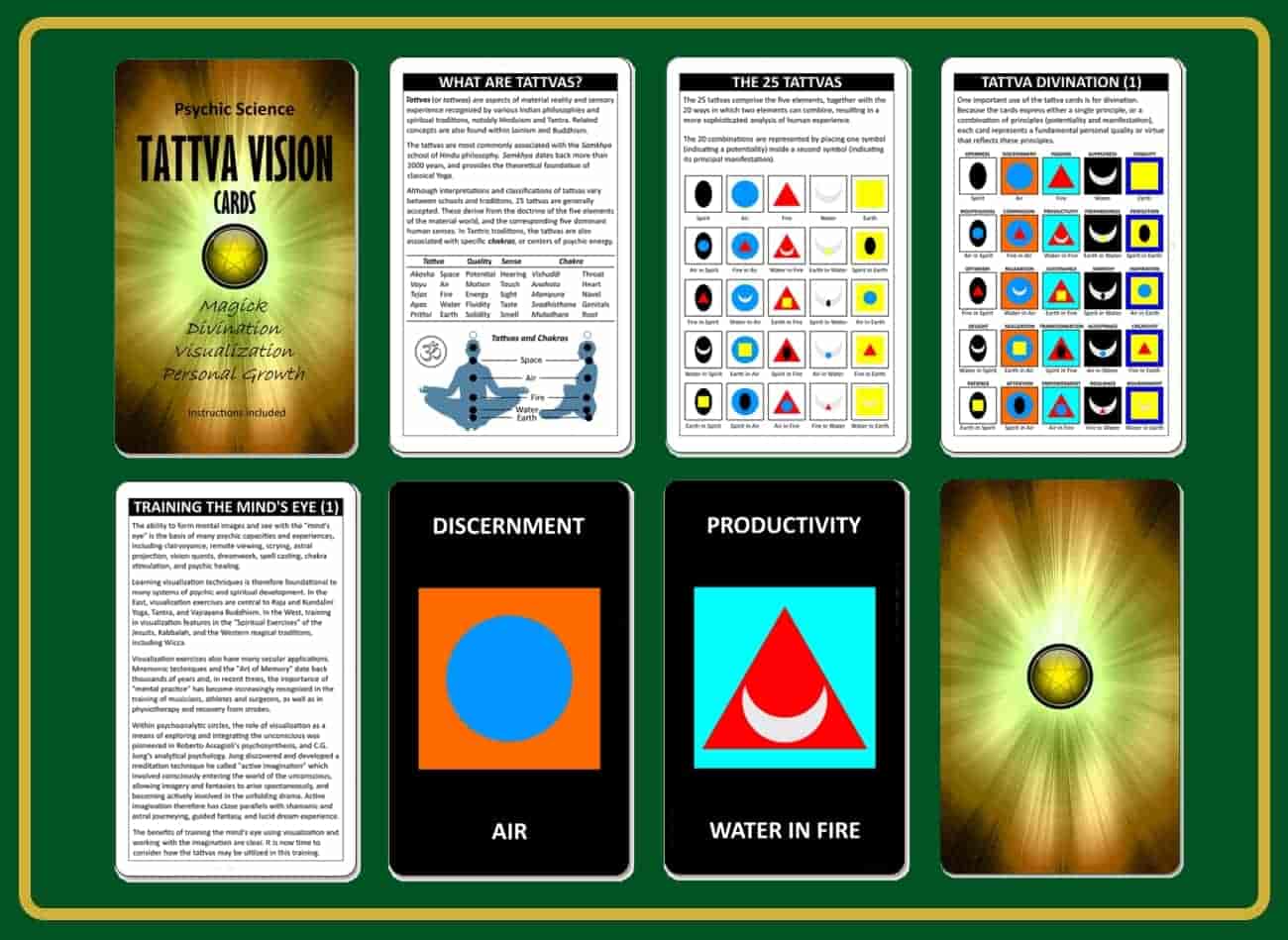
If you wish to explore visualization training using the tattvas, you can buy a complete set of TATTVA VISION FLASHING COLOR CARDS - direct from the manufacturer.
The exclusive Psychic Science Tattva Vision cards also include key words and elemental principles as aids to meditation, and for use in divination.
The 32-card deck includes:
25 Flashing Color Tattva Cards with element labels and divinatory key words (5 single element and 20 double element).
7 information and instruction cards for divination, visualization training, magical pathworking, and other uses.
To facilitate flashing color visualization, the cards are printed on LARGE (3.5 x 5.75 inch) high-quality 100% PLASTIC CARD STOCK and are presented in an all-white tuck box. Each card is more than twice the area of a standard poker-size playing card.